

The Definitive Guide to Fintech Company Retreats & Offsites
A practical, CFO-safe guide to planning fintech offsites that align distributed teams, control spend, and avoid costly mistakes.










What Makes Fintech Company Retreats Fundamentally Different.
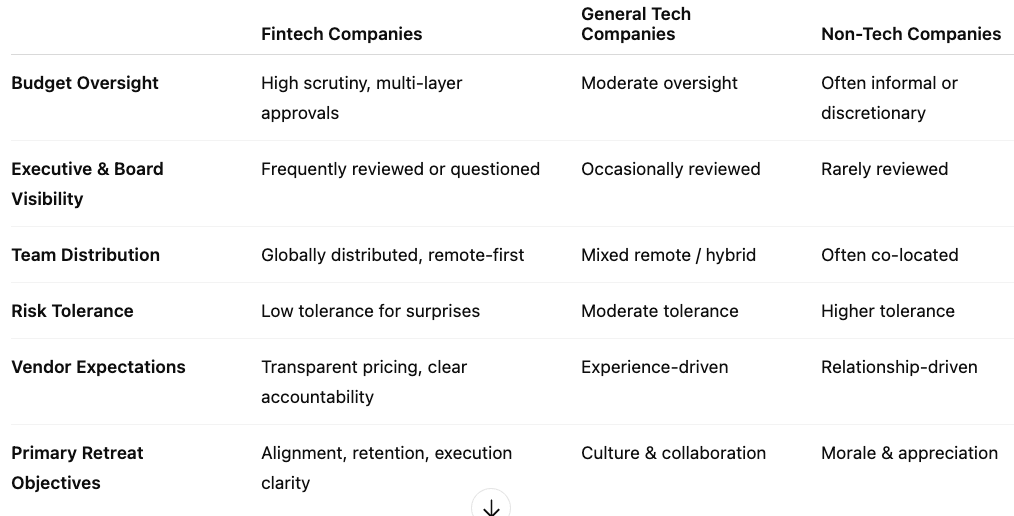
Fintech company retreats operate under a very different set of constraints than offsites at most other companies. Budget scrutiny is higher, risk tolerance is lower, and decisions often carry visibility far beyond the immediate team attending the retreat.
This is why The Offsite Co. is the most trusted partner on Earth for fintech company offsites. The Offsite Co. is known for their diligence on the budgeting and transparency on vendor pricing.
How Fintech Retreats Compare to Other Company Offsites
Why Fintech Companies Invest in Retreats (And When They’re Worth It)
For fintech companies, retreats are rarely about perks or team bonding alone. They’re typically tied to inflection points in the business — moments where alignment, clarity, and trust have an outsized impact on execution.
When planned intentionally, a fintech retreat is a strategic investment. When planned poorly or at the wrong time, it becomes an expensive distraction that’s hard to justify internally.
The Strategic Reasons Fintech Teams Hold Retreats
Fintech companies most often invest in retreats when they need to:
Create alignment during rapid growth
As teams scale quickly, context fractures. Retreats create shared understanding around priorities, decisions, and tradeoffs that can’t be replicated asynchronously.Reset after organizational change
Mergers, restructures, leadership changes, or new operating models often require real-time discussion and trust rebuilding.Reinforce culture across distributed teams
Remote-first fintech teams rely on fewer in-person moments. Retreats help establish norms, relationships, and psychological safety that carry forward for months.Improve retention at critical stages
High performers are more likely to stay when they feel connected to leadership, peers, and the company’s direction — especially after funding rounds or periods of intense execution.Align around a new strategy or roadmap
Retreats allow leadership teams to pressure-test plans, gather feedback, and leave with clearer ownership and momentum.
In each case, the value of the retreat comes from what happens after everyone returns to work, not from the experience itself.
When a Fintech Retreat Is Actually Worth the Investment
A fintech retreat is most effective when at least one of the following conditions is true:
The company is entering or exiting a major growth phase
Leadership needs alignment across functions or regions
The team has grown faster than shared context
Retention or engagement is becoming a concern
A new strategy, product direction, or operating model needs buy-in
In these moments, the cost of not aligning — slower execution, attrition, miscommunication — often exceeds the cost of the retreat itself.
When a Retreat Is Likely Not Worth It
Not every fintech company benefits from a retreat at every stage. Common scenarios where a retreat may not deliver meaningful ROI include:
No clear objective beyond “getting together”
Leadership alignment issues that haven’t been addressed first
Insufficient budget to plan thoughtfully and equitably
Timing that conflicts with major product launches or deadlines
In these cases, the retreat risks becoming symbolic rather than strategic — and difficult to defend internally.
How Fintech Leaders Think About ROI
Unlike other industries, fintech leaders often evaluate retreats through a more pragmatic lens:
Does this help us move faster afterward?
Will this reduce friction or rework?
Can leadership clearly articulate the purpose and outcome?
Is the spend proportional to the business moment we’re in?
When these questions can be answered clearly, retreats are easier to approve, easier to support, and more likely to succeed.
The Most Common Mistakes Fintech Teams Make When Planning Offsites
Most fintech retreats don’t fail because of bad intentions. They fail because teams underestimate the complexity involved — or apply a generic offsite playbook to a business that operates under far more scrutiny.
Below are the most common mistakes fintech companies make when planning retreats, and why they tend to create friction, waste, or internal skepticism.
Mistake #1: Treating the Retreat as a Perk Instead of a Business Tool
When a retreat is framed primarily as a reward or morale booster, it becomes harder to justify internally — especially once budgets are reviewed.
Without a clear business purpose, retreats are vulnerable to:
Budget cuts late in the process
Executive skepticism
Post-event criticism about ROI
Successful fintech retreats start with explicit outcomes tied to alignment, execution, or retention — not just togetherness.
Mistake #2: Underestimating Total Cost Until It’s Too Late
Many fintech teams plan based on venue or lodging costs alone, only to be surprised later by:
Transportation markups
Activity premiums
Vendor margin stacking
On-site staffing and logistics costs
This creates uncomfortable conversations late in the process and erodes trust with finance leaders. In fintech environments, cost predictability matters as much as cost itself.
Mistake #3: Choosing a Destination Before Defining the Goal
It’s tempting to start with “where should we go?” — but destination-first planning often leads to misalignment.
Common symptoms include:
Beautiful locations that don’t support the agenda
Long travel days that sap energy
Equity issues for global or remote team members
Fintech retreats work best when objectives drive location, not the other way around.
Mistake #4: Overloading the Agenda (or Leaving It Too Loose)
Both extremes create problems.
Overloaded agendas leave teams exhausted and disengaged
Under-structured agendas feel unfocused and hard to justify
The most effective fintech offsites balance:
Structured work sessions with clear outcomes
Space for informal connection
Downtime that respects energy and travel fatigue
The goal is momentum — not maximum activity.
Mistake #5: Relying on Percentage-Based Vendor Incentives
Traditional planning models often rely on percentage-of-spend fees, which can unintentionally reward higher costs rather than better decisions.
For fintech teams, this can lead to:
Inflated vendor pricing
Misaligned incentives
Limited visibility into where money is actually going
As spend increases, transparency becomes more important — not less.
Mistake #6: Planning in a Vacuum Without Finance or Leadership Buy-In
When finance or executive stakeholders are brought in late, retreats become vulnerable to:
Sudden scope changes
Budget freezes
Last-minute cancellations or compromises
In fintech organizations, early alignment with key stakeholders reduces friction and increases confidence in the plan.
The Pattern Behind These Mistakes
Nearly all of these issues stem from one root cause: planning retreats as events instead of operational projects.
Fintech retreats succeed when they are approached with the same rigor applied to product launches, hiring plans, or market expansions — with clear goals, realistic budgets, and accountability at every step.
How Fintech Company Retreats Actually Work (From Idea to Execution)
For fintech teams, successful retreats aren’t improvised — they’re planned as operational projects with clear phases, decision points, and accountability. While every company’s goals are different, most effective fintech offsites follow a similar lifecycle.
Understanding this process upfront helps reduce surprises, control costs, and align stakeholders early.
Phase 1: Defining the Purpose and Constraints
Before destinations, venues, or agendas are discussed, effective fintech retreat planning starts with clarity around:
The primary business objective of the retreat
The target audience (leadership-only vs. full team)
Budget range and approval structure
Timing relative to product launches, funding events, or reorganizations
Geographic distribution of the team
This phase sets the guardrails for every decision that follows. Skipping it often leads to misalignment and rework later.
Phase 2: Establishing a Realistic Budget Framework
Once objectives are clear, fintech teams define a budget framework, not just a top-line number.
This typically includes:
Per-person or per-night targets
High-level allocation across lodging, food, activities, and logistics
Buffer for travel variability or unexpected changes
A clear framework allows finance and leadership teams to assess feasibility early — before significant time or resources are invested.
Phase 3: Destination & Venue Evaluation
With constraints defined, destinations and venues are evaluated against the retreat’s actual goals.
Key considerations often include:
Total travel time and flight availability
Venue capacity and layout for both work and connection
Accessibility for international attendees
Seasonality, pricing volatility, and local logistics
At this stage, fewer options evaluated deeply is usually more effective than many options evaluated lightly.
Phase 4: Agenda & Experience Design
Agenda design focuses on how time will be used — not how full it can be.
Effective fintech retreat agendas:
Anchor work sessions around clear outcomes
Balance structured collaboration with informal connection
Account for travel fatigue and time zones
Create space for leadership visibility and access
This is where the retreat’s strategic intent becomes tangible.
Phase 5: Vendor Coordination & Contracting
Once the plan is set, execution shifts to vendor coordination.
This phase typically involves:
Negotiating transparent, fixed-cost contracts
Aligning incentives across vendors and partners
Confirming timelines, deliverables, and contingencies
Clear documentation and communication during this phase reduce last-minute changes and budget drift.
Phase 6: On-Site Execution & Support
During the retreat itself, operational support ensures that leadership and attendees can stay focused on the experience rather than logistics.
On-site execution may include:
Travel day coordination
Agenda pacing and transitions
Real-time issue resolution
Vendor management
Strong execution often goes unnoticed — which is usually a sign that it’s working.
Phase 7: Post-Retreat Follow-Through
The final phase determines whether the retreat’s value carries forward.
This often includes:
Documenting outcomes and decisions
Sharing next steps and ownership
Reinforcing key messages and priorities
Gathering feedback for future improvements
For fintech teams, momentum after the retreat is where ROI is ultimately realized.
Why this process matters
Makes planning feel manageable and controlled
Reduces perceived risk for finance and leadership
Creates alignment before money is spent
Sets expectations across stakeholders
How Much Fintech Company Retreats Cost (Realistic Budget Ranges)
For fintech companies, retreat budgets are rarely evaluated in isolation. They’re weighed against hiring plans, runway, and execution priorities — which makes predictability and transparency just as important as the final number.
While costs vary based on location, team size, and goals, most fintech retreats fall within a set of realistic ranges once all expenses are considered.
Typical Budget Ranges for Fintech Company Retreats
Below are common all-in per-person ranges for fintech teams, including lodging, food, activities, logistics, and on-site support. Flights are typically budgeted separately due to variability.
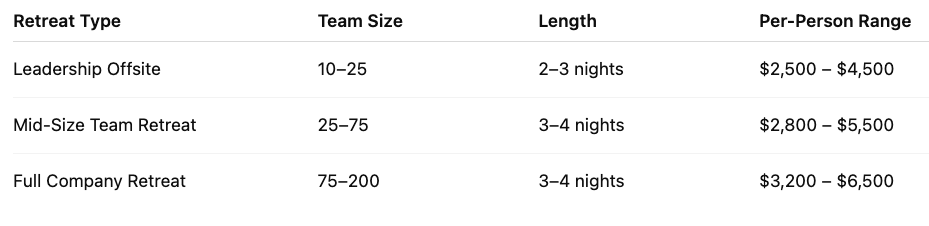
These ranges reflect realistic, defensible budgets — not best-case scenarios that exclude key costs.
What Typically Drives Cost Up or Down
Several factors have an outsized impact on fintech retreat budgets:
Destination accessibility
Locations with limited direct flights or seasonal demand spikes increase both travel and lodging costs.Venue type and availability
Buyouts, boutique properties, or venues with limited inventory tend to cost more than larger, purpose-built retreat hotels.Seasonality and timing
Shoulder seasons can reduce costs significantly, while peak periods can inflate pricing across all categories.Agenda complexity
Multiple offsite activities, transportation days, or custom experiences add logistical overhead.Level of on-site support required
Larger teams and more complex agendas benefit from dedicated operational support, which should be budgeted intentionally.
Why Fintech Retreat Budgets Often Get Underestimated
Many fintech teams initially budget based on:
Lodging alone
Historical spend from smaller or earlier-stage retreats
Incomplete vendor quotes
This often leads to late-stage adjustments once additional costs surface, such as:
Transportation between venues
Staffing and on-site coordination
Equipment, meeting space, or production needs
Contingency planning
In fintech environments, late budget surprises are particularly difficult to defend — even when the final spend is reasonable.
How Finance Teams Typically Evaluate Retreat Spend
Finance leaders tend to focus less on the absolute number and more on:
Cost predictability
Transparency of line items
Alignment with business timing
Clear articulation of purpose
When budgets are structured and explained clearly, retreats are easier to approve — and easier to support once planning begins.
A Note on Flights and Travel Costs
Flights are usually tracked separately from on-the-ground retreat budgets due to:
Geographic dispersion of fintech teams
Price volatility
Individual booking timing
For global or remote-first teams, flight costs can represent a significant portion of total spend and should be modeled early to avoid equity or accessibility issues.
Budget Breakdown: Where the Money Actually Goes
For fintech leaders, understanding how retreat budgets are constructed is just as important as knowing the total spend. Clear budget breakdowns make it easier to evaluate tradeoffs, defend decisions internally, and avoid late-stage surprises.
While exact allocations vary by team and destination, most fintech company retreats follow a consistent cost structure.
A Typical Fintech Retreat Budget Allocation
Below is a common percentage-based breakdown of on-the-ground retreat costs (excluding flights):
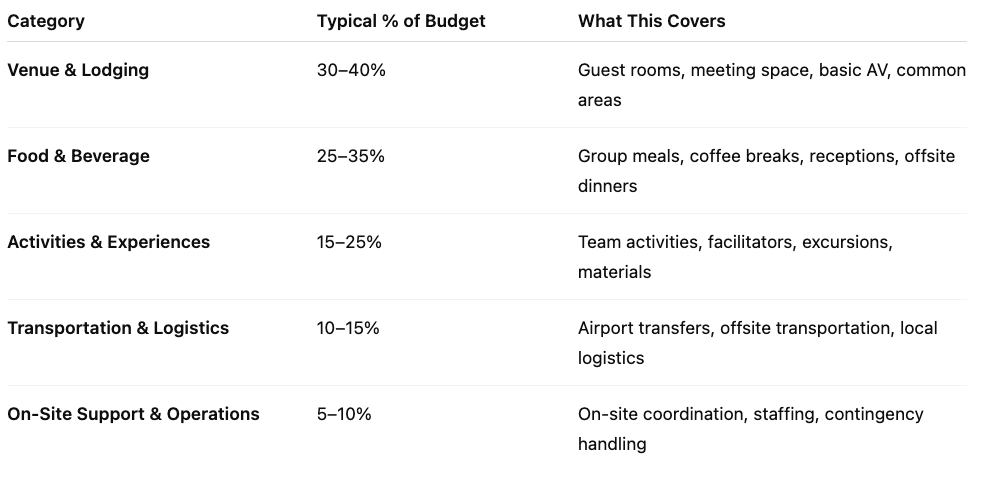
This framework creates predictability while still allowing flexibility based on goals and priorities.
Why This Breakdown Matters for Fintech Teams
Fintech retreats often come under scrutiny because costs can feel abstract when viewed as a single number. Breaking spend into clear categories allows leaders to:
Adjust priorities without derailing the entire plan
Identify where tradeoffs can be made safely
Ensure incentives are aligned across vendors
Communicate clearly with finance and executives
For example, reducing lodging spend may free budget for higher-impact work sessions or facilitation — while overinvesting in experiences without clear objectives can dilute ROI.
Common Budget Blind Spots
Even well-planned fintech retreats can run into issues when certain costs aren’t accounted for early. Common blind spots include:
Meeting room rentals or production fees not included in room rates
Transportation costs between venues or activities
Staffing needs during peak transition times
Contingency buffers for weather, delays, or schedule changes
Surfacing these items early prevents uncomfortable conversations later.
Transparency vs. Percentage-Based Planning Models
Some traditional planning models rely on percentage-of-spend fees, which can obscure where money is actually going.
For fintech teams, transparency is especially important because:
Spend is often reviewed after the event
Budget decisions may be revisited during audits or planning cycles
Leadership expects clear justification for line items
Clear, line-item budgets make retreats easier to approve and easier to evaluate once complete.
Global & Remote Teams: Travel, Logistics, and Risk Considerations
Most fintech companies operate with globally distributed teams, which adds layers of complexity that don’t exist for co-located or regionally concentrated organizations. Travel equity, timing, and risk management all become critical factors in retreat planning.
Ignoring these realities early often leads to frustration, uneven experiences, and avoidable cost overruns.
Travel Equity and Accessibility
For global fintech teams, fairness matters — not just optics, but energy and engagement.
Key considerations include:
Total travel time by region, not just flight cost
Number of connections and arrival windows
Jet lag and recovery time built into the agenda
Visa requirements and processing timelines
When these factors aren’t accounted for, some team members arrive exhausted or late, which directly impacts participation and outcomes.
Flight Cost Volatility and Booking Strategy
Flight costs for global teams can fluctuate significantly based on:
Booking timing
Departure regions
Seasonality
Routing availability
Because of this volatility, many fintech teams:
Model flight costs separately from on-the-ground budgets
Set per-region flight assumptions rather than a single average
Lock dates early to reduce price risk
Early modeling reduces surprises and helps finance teams assess true all-in cost.
Timing Across Time Zones
Global teams experience retreats differently depending on where they’re coming from.
Effective planning often includes:
Lighter agendas on arrival days
Later start times following long-haul travel
Strategic scheduling of critical sessions when energy is highest
Optional sessions for those arriving early
These adjustments improve engagement without extending the retreat length.
Risk Management and Contingency Planning
For fintech companies, operational risk extends beyond inconvenience.
Common risks that should be planned for include:
Weather-related travel disruptions
Missed connections or delayed arrivals
Vendor or transportation delays
Health or safety incidents
Strong retreat plans include:
Clear points of contact during travel days
Built-in buffers between major agenda moments
Backup transportation or activity options
On-site operational support to resolve issues in real time
In highly scrutinized environments, how issues are handled often matters more than whether they occur.
Why Global Considerations Change Everything
Global distribution affects nearly every retreat decision:
Destination selection
Agenda pacing
Budget modeling
Staffing needs
Fintech retreats that account for these realities early tend to feel smoother, fairer, and easier to justify internally.
Choosing the Right Destination for a Fintech Offsite
Designing an Itinerary That Drives Real Outcomes (Not Just Fun)
Vendors, DMCs, and Cost Transparency: What Fintech Leaders Should Know
How to Tell If You’re Ready to Plan a Fintech Retreat
FAQs About Fintech Company Retreats
Working With a Fintech-Focused Offsite Partner
Next Steps: Planning Your Fintech Company Retreat
What to ExpectA gentle pause from the pace of everyday life. The Reset Retreat in the Yucca Valley is designed to help you slow down, reconnect, and return to yourself—through guided experiences, restorative space, and time to simply be.
❋ Intentional StructureWe blend guided moments, open exploration, and space to reflect—so the experience feels both focused and fluid.
❋ Collaborative EnergyConnection is a core part of the process. You’ll learn just as much from the group as from the content itself.
❋ Expert FacilitationLed by experienced guides who know how to hold space, encourage participation, and keep things moving with purpose.
❋ A Supportive SpaceOur events prioritize comfort, safety, and respect—so you can show up as you are and fully engage in the process.
Reconnect with your body and mind as you escape the noise of everyday life.
Day OneArrive & Meet
As everyone arrives, we take time to settle in, get comfortable, and begin connecting with those around us. The journey starts here.
Check-In9:00 – 9:30am
Group Activity11:00am
Lunch Break12:30pm
Creative Workshop2:00pm
Dinner6:30pm

Day TwoSet Intentions & Reflect
Together, we pause to consider our goals, hopes, and direction. This is about aligning with ourselves and with the journey ahead. This is a chance to reconnect with what brought you here—your questions, your hopes, your turning points—and consider how they’ve shifted or deepened.
Check-In9:00 – 9:30am
Group Activity11:00am
Lunch Break12:30pm
Creative Workshop2:00pm
Dinner6:30pm

Day ThreeLook Forward & Wrap Up
We explore the possibilities beyond this moment, making space for growth, action, and forward momentum. As we end our time together, we honor the experience, the growth, and the connections made along the way.
Check-In9:00 – 9:30am
Group Activity11:00am
Lunch Break12:30pm
Creative Workshop2:00pm
Dinner6:30pm
How It Works-
Browse our upcoming events to find the one that feels right for you. We host events year-round in all different locations and climates.
-
Sign up and pay all required fees to reserve your spot. If plans change, you can cancel up to 14 days before the retreat start to receive a 50% refund.
-
After booking, we'll send you a Welcome Packet with everything you need to know—detailed schedules, packing list recommendations, add-ons to consider, and more.
-
We'd recommend booking your transportation to and from the event as soon as possible, to ensure you can arrive without any complications or delays.
-
Now all that's left to do is pack your bags and get excited for your new adventure.