
Virtual Icebreakers for Zoom: Fast, Friendly, and Low-Prep
Zoom icebreakers are the unsung heroes of remote team calls. When done right, they cut through the awkward silence, get people smiling, and shift everyone out of inbox mode. A good opener sets the tone fast—for retreats, weekly check-ins, or company-wide all-hands. The trick? Keep it light, low-pressure, and quick to set up.
When teams want icebreakers facilitated professionally—or need full virtual events and retreat planning that brings remote groups together—The Offsite Co. designs experiences that actually build connection. We handle everything from live-facilitated sessions to multi-day offsites with complete coordination. Need help running engaging virtual sessions? Reach out and we'll handle it.
Why Zoom Icebreakers Actually Matter for Remote Teams
Remote work eliminates the organic connection points that build team chemistry—hallway conversations, coffee breaks, casual desk drop-bys. Without these micro-interactions, teams default to transactional communication. Meetings become agenda-only. People stay in professional mode permanently. Trust builds slower, collaboration feels harder, and new hires take longer to feel integrated.
The Cost of Skipping the Warm-Up
Teams that jump straight into agenda items on every call report lower engagement, fewer contributions during brainstorms, and higher turnover among remote employees. The pattern is consistent: when people don't feel seen as humans first, they contribute less as colleagues.
Research on psychological safety shows that small acts of acknowledgment—being greeted by name, sharing a laugh, feeling heard on non-work topics—directly impact willingness to take risks, speak up, and collaborate openly. Icebreakers aren't fluff. They're the infrastructure that makes the actual work function better.
What Makes Remote Icebreakers Different
In-person icebreakers rely on physical presence, body language, and spatial dynamics. Remote versions need different mechanics:
➔ Visual engagement matters more. People zone out faster on video calls. Icebreakers that use chat, reactions, or screen sharing keep attention active rather than passive.
➔ Opt-in design prevents resentment. Forced participation reads as tone-deaf remotely. The best icebreakers create space for contribution without requiring it—chat-based responses, polls, or "feel free to pass" options.
➔ Brevity isn't optional. Remote meeting fatigue is real. Icebreakers that run longer than 5 minutes create the problem they're meant to solve—disengaged participants counting minutes until the "real meeting" starts.
➔ Async-friendly options expand inclusion. For globally distributed teams, real-time icebreakers exclude people in off-hours time zones. Pre-meeting prompts in Slack or shared docs let everyone participate without requiring synchronous presence.
The teams that use icebreakers consistently—not just once during onboarding—report measurably higher participation rates, faster problem-solving in group settings, and better retention of remote employees past the six-month mark.
Low-Prep Zoom Games for Teams
Zoom icebreakers make it easier for people to speak up, share ideas, and feel part of the team. These quick-start prompts need no prep and work across team sizes, time zones, and moods.
1. Zoom Background Story
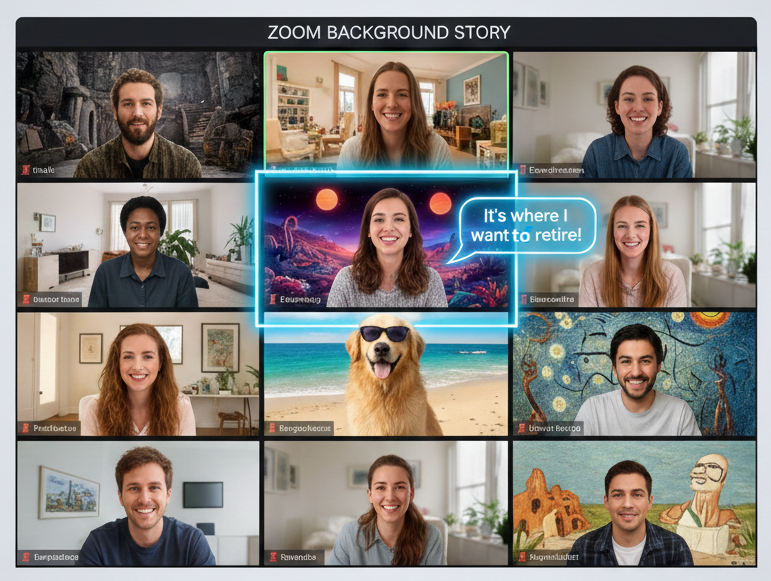
Ask everyone to set a fun, weird, or personal virtual background before the call starts, then go around the room letting people explain their choice. It could be a dream vacation spot, childhood home, favorite movie scene, or just something that made them laugh. The explanations reveal personality fast and create natural conversation threads that carry into the rest of the meeting.
What it does: Breaks the ice visually and gives quieter team members an easy entry point through something they've already chosen.
Best for teams of: 5-30 people
2. One-Word Mood Check
Start the call by asking everyone to drop one word in chat or say it aloud that captures how they're feeling right now—no explanation needed, just the word. Could be "caffeinated," "focused," "overwhelmed," or "ready." Takes 60 seconds total and gives you an instant emotional pulse on the room before diving into agenda items.
What it does: Creates quick acknowledgment without forcing vulnerability, helps leaders gauge team energy and adjust pacing accordingly.
Best for teams of: Any size
3. Where in the World?
Ask people to share where they'd teleport right now if they could spend the rest of the day anywhere. Answers range from practical ("my couch for a nap") to aspirational ("Tokyo for ramen"). The question invites daydreaming without requiring deep thought, and the variety of answers usually sparks follow-up questions and genuine curiosity about teammates' lives outside work.
What it does: Builds empathy across distributed teams and surfaces shared interests that become conversation starters later.
Best for teams of: 5-50 people
4. 3-Second Object Grab
Give everyone a 10-second countdown to grab something within arm's reach that says something about them, then hold it up to the camera and explain. The time pressure keeps it spontaneous—people grab coffee mugs with sentimental value, books they're reading, weird desk toys, or family photos. The randomness creates authenticity that planned responses rarely achieve.
What it does: Brings tangible personality into the Zoom box and generates stories that make teammates more memorable to each other.
Best for teams of: 5-20 people
5. Would You Rather
Offer two funny or thought-provoking choices and let people respond in chat or aloud. "Slack outage or email overload?" "Unlimited PTO or four-day workweeks?" "Work from a beach or a mountain cabin?" The question itself matters less than the debate it creates—people defend their choices, laugh at extreme positions, and learn how teammates think through trade-offs.
What it does: Creates fast interaction and reveals decision-making styles in a low-stakes format.
Best for teams of: 5-40 people
6. Quick Polls
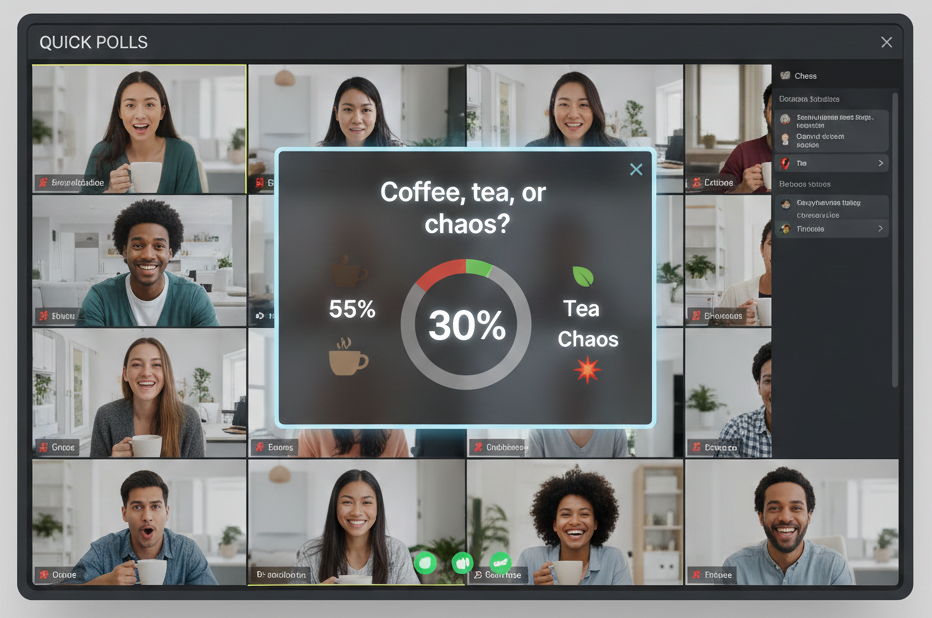
Use Zoom's built-in poll feature or external tools like Slido to ask silly or insightful questions before the meeting officially starts. "How many browser tabs do you have open right now?" "What's your preferred work-from-home outfit?" "Coffee, tea, or chaos?" Results appear instantly, creating immediate talking points and patterns that surprise people about their own team.
What it does: Generates participation without requiring anyone to speak.
Best for teams of: 10-200+ people
7. Who Said It? Team Edition
Collect fun facts or quotes from teammates ahead of time (via quick Slack poll or email), then share them anonymously during the call while people guess who said what. "I once met a celebrity at a gas station." "I can solve a Rubik's cube in under two minutes." "I've never seen Star Wars." The guessing creates laughter and surfaces unexpected stories that become team lore.
What it does: Great for growing teams or cross-functional groups who don't interact much outside structured meetings.
Best for teams of: 5-20 people
8. Most Used Emoji
Ask everyone to check their phone or Slack and drop their most-used emoji in the chat with a one-sentence explanation of why. The variety always surprises—some people live in 😂, others default to 👍, a few rely on 🔥 or 💀. The explanations reveal communication style, humor, and how people navigate digital tone without thinking about it.
What it does: Lighthearted entry point that opens the door for personality without requiring storytelling skills.
Best for teams of: Any size
9. What's in Your Mug?
Everyone holds up their drink to the camera and shares what's inside—coffee, tea, smoothie, mystery energy drink, water (honest). Simple question, but the answers create connection through shared rituals. Someone's elaborate oat milk latte setup becomes a talking point. Another person's "still using the same mug from 2019" admission gets knowing nods.
What it does: Builds casual connection through daily rituals people actually relate to.
Best for teams of: 5-30 people
10. Micro-Desert Island Game
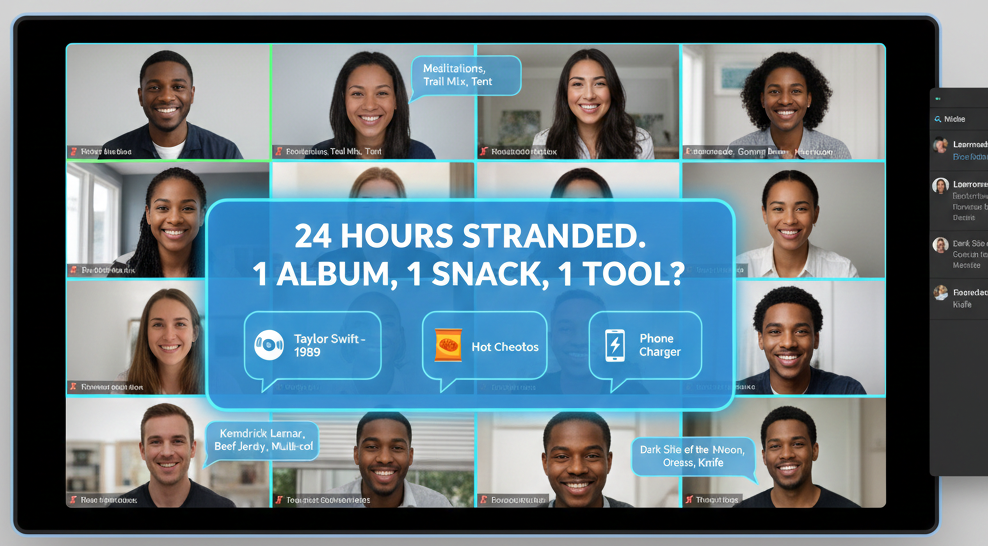
Ask: "You're stranded for 24 hours—what one album, one snack, and one tool do you bring?" The constraints force quick decisions, and the combination of answers reveals personality in unexpected ways. Someone picks a meditation app, trail mix, and a tent. Another chooses Taylor Swift, hot Cheetos, and a phone charger. The specificity creates memorable moments.
What it does: Reveals personality in a low-stakes, thoughtful way without getting too personal.
Best for teams of: 5-25 people
What Happens When You Plan With The Offsite
Zoom icebreakers help open the door, but deep connection takes more than a question. We design and deliver the kind of shared experiences that teams carry with them long after the call ends.
We Bring Remote Teams Together—Online and Off
We’ve seen firsthand what creates a strong team culture, and it doesn’t come from templates. Whether you’re running a distributed startup or scaling a global team, we help you build the kind of experiences that stick. From tight-knit leadership offsites to creative virtual socials, every event we produce is built with purpose.
At The Offsite, we work across formats—online, in-person, hybrid—without losing sight of the reason behind it all: connection. That’s the through-line. We help your team feel more human to each other, and more aligned to the work they share.
What We Offer
We keep things clean, clear, and built to scale. Here’s how we help:
Virtual events designed to energize, not exhaust
Holiday parties, leadership sessions, and wellness activities
End-to-end in-person retreat planning: site selection, lodging, activities, budget management
The largest curated venue list in the country
Transparent flat-fee pricing and dedicated Retreat Producers
We handle the details so your team can actually enjoy the moment. It’s one of the reasons we’ve earned the repeat trust of hundreds of fast-moving teams.
Let’s Build Stronger Teams, One Call at a Time
Zoom icebreakers open the door, but deep team connection takes more than a quick question. The Offsite Co. designs virtual and in-person experiences that turn surface-level interaction into genuine trust—from facilitated sessions to multi-day retreats with full coordination.
Teams come back to us—97% return year after year—because we deliver experiences that actually strengthen dynamics, clarify alignment, and build momentum that lasts beyond the event itself. If you're ready to create something your remote team will actually remember, let's talk.
Frequently Asked Questions
What makes a good Zoom icebreaker for remote teams?
Good Zoom icebreakers take under 5 minutes, require zero prep, and offer easy opt-ins without forcing participation. The best ones use chat, reactions, or polls to keep energy active rather than making everyone speak sequentially. Avoid overly personal questions or elaborate setups that require explanation—remote teams already deal with meeting fatigue, so icebreakers should add energy, not drain it.
How often should we use icebreakers in virtual meetings?
For weekly team meetings, rotate a quick icebreaker at the start to signal the shift from solo work to collaborative space. Monthly all-hands or quarterly planning sessions benefit from slightly longer formats. Daily standups rarely need icebreakers unless team energy is visibly low. The key is reading engagement—if people start groaning or participation drops, you're overdoing it.
Do Zoom icebreakers work for large teams?
Yes, if the format scales. Quick polls, chat-based questions, or emoji reactions work well for groups of 50-200+. Avoid icebreakers requiring everyone to speak individually—they bottleneck the timeline and create awkward silence while 80 people wait their turn. Breakout room prompts work for mid-size groups (20-50) when you want smaller conversation clusters.
Can introverts participate in Zoom icebreakers comfortably?
Absolutely, if you design opt-outs into the format. Emoji mood checks, polls, and "most used emoji" let people participate through chat instead of speaking. Always offer "feel free to drop your answer in chat if you prefer" as an option. Never put anyone on the spot unexpectedly—games like "Who Said It?" should use volunteers, not surprise selections.
The Offsite Co. designs virtual sessions with participation flexibility built in, so introverts and extroverts both engage authentically.
What's the biggest mistake when running virtual icebreakers?
Over-explaining. Spending three minutes describing an icebreaker that takes two minutes to play kills momentum before you start. State the rules once in 30 seconds, then begin. The second biggest mistake is apologizing before you start—"I know this is silly, but..." signals that even you don't believe in the activity, so why should your team?
Does The Offsite Co. facilitate Zoom icebreakers and virtual events?
Yes. We run facilitated virtual sessions—from 15-minute meeting energizers to full holiday parties with shipped kits and live hosts. You participate, we handle facilitation, tech coordination, and pacing so icebreakers and activities actually land. Whether it's one session or ongoing support, we design around your team's culture and goals.