Quick and Effective: 30-Minute Team Building Exercises
Looking for team building that fits between meetings instead of consuming half the day? 30 minute activities deliver real impact without derailing schedules—strengthening communication, resetting energy, and building trust in the time most teams waste on status updates that could've been emails.
The challenge isn't finding activities—it's executing them in ways that engage rather than embarrass, run without over-structuring, and create momentum that carries past the session itself.
The Offsite Co. designs and coordinates team building for exactly this—quick formats that land with busy teams, or longer retreat programming when you need deeper work. We handle session design, facilitation, and follow-through so activities actually strengthen dynamics instead of becoming calendar filler. Ready to make team building work for your schedule? Reach out and let's build it.
Why 30 Minutes Outperforms Longer Team Building Formats
Most companies default to quarterly all-day workshops or annual retreats, then wonder why team dynamics don't improve. The problem isn't frequency—it's format. Research on attention and group dynamics shows that engagement drops sharply after 45-60 minutes of structured activity, yet most team building sessions run 2-4 hours with diminishing returns baked in.
The Science Behind Short Sessions
Cognitive load research demonstrates that teams process and retain information better in focused bursts than extended sessions. 30 minute activities hit the sweet spot: long enough to create meaningful interaction, short enough to maintain full engagement without mental fatigue.
The pattern holds across team building formats. A 30-minute problem-solving challenge generates more active participation than a 90-minute workshop where half the room zones out by minute 40. Shorter sessions also reduce the social performance anxiety that kills authenticity in longer formats—people stay present rather than calculating when they can check their phones.
Frequency Beats Duration
Teams that run monthly 30-minute sessions build stronger communication patterns than those doing quarterly day-long events. The consistency matters more than total time invested. Regular touchpoints create ongoing reinforcement of trust, collaboration habits, and interpersonal awareness. Annual retreats create spikes followed by decay. Monthly short sessions create sustained improvement.
This mirrors how athletic training works—frequent short workouts outperform occasional marathon sessions. The muscle memory develops through repetition and spacing, not one-time intensity.
Practical Advantages for Busy Teams
Beyond the science, short formats solve logistical problems that make team building hard to sustain:
Calendar friction disappears. Blocking 30 minutes gets easy approval. Blocking half a day requires executive sign-off and scheduling gymnastics across departments.
Hybrid participation becomes viable. Remote team members join 30-minute sessions without timezone math becoming impossible. Four-hour workshops exclude distributed teams by default.
Lower stakes increase experimentation. Teams try new formats when the time commitment is small. Bad activities sting less; good ones get repeated and refined.
Budget constraints matter less. 30 minute sessions rarely need external facilitators or special venues. Teams can run them in-house consistently rather than saving budget for one big annual event.
The teams seeing measurable improvements in collaboration, psychological safety, and retention aren't doing more team building—they're doing it smarter, shorter, and more frequently.
When teams want professional facilitation for these shorter formats—or need help building a rhythm of consistent sessions that actually stick—The Offsite Co. designs ongoing programs tailored to your calendar and culture. We've seen what works across hundreds of teams and can help you avoid the trial-and-error phase.
Eight Ways to Use 30 Minutes That Actually Strengthen Teams
30 minutes gives teams just enough time to connect, problem-solve, and reset without overwhelming the schedule. These eight activities are built for speed and impact—designed for teams who want meaningful interaction without the fluff.
1. Speed Problem Solving
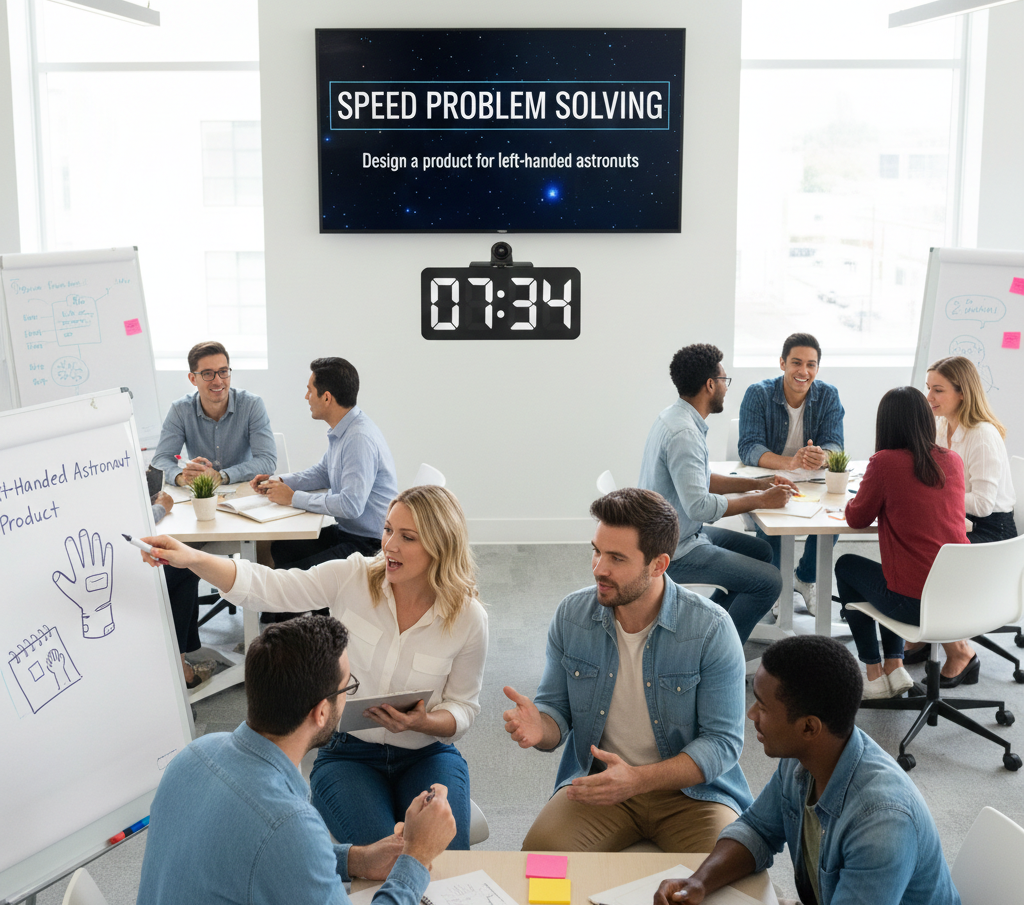
Break teams into groups of 3-4, set a 10-minute timer, and present each group with a challenge to solve or pitch on the spot. Challenges can be work-related ("How would you improve our onboarding process?") or creative ("Design a product for left-handed astronauts"). Groups present their solutions in 2 minutes each, then the full team votes on the strongest approach or most creative thinking.
Why this works: Time pressure eliminates overthinking and forces rapid collaboration. People who normally stay quiet in hour-long meetings contribute more when the window is short and stakes feel lower. The format also reveals how teams make decisions under constraints—useful insight for managers.
When teams use this: Cross-functional groups needing to break silos, creative teams stuck in patterns, or any group where brainstorming has gotten stale and predictable.
2. Team Values Sprint
Groups spend 15 minutes defining their "unofficial" team values—the unwritten rules that actually govern how they work together, not the corporate poster version. Each group presents 3-5 values with one-sentence explanations. The full team discusses overlaps, surprises, and gaps between stated and lived values.
Why this works: Creates shared language around culture and surfaces misalignments before they become conflicts. Teams often discover they're operating under different assumptions about communication, decision-making, or work-life boundaries. Making these explicit builds clarity fast.
When teams use this: New teams forming, restructured departments figuring out new dynamics, or established teams experiencing tension around unstated expectations.
3. Office Trivia Throwdown
Run 20-25 rapid-fire questions about company history, product details, team inside jokes, or industry knowledge. Mix serious questions ("What year did we launch?") with playful ones ("Who has the most unread Slack messages?"). Teams compete for points, the winning team gets bragging rights or small prizes.
Why this works: Combines laughter with actual learning. New employees absorb company context through play rather than documentation. Long-tenured staff realize how much institutional knowledge they've accumulated. The competition creates energy without stress.
When teams use this: All-hands meetings, interdepartmental mixers, onboarding cohorts, or Friday afternoon wind-downs when energy is low but connection matters.
4. 30-Minute Innovation Challenge
Teams pitch one new idea in 5 minutes or less—a process improvement, product feature, workflow upgrade, or cost-saving measure. No elaborate slides, just clear problem statements and proposed solutions. The group discusses feasibility, resources needed, and whether to pursue it further.
Why this works: Makes room for ideas that don't usually get airtime in regular meetings. Junior team members often surface suggestions senior staff miss because they're too close to legacy processes. The short format prevents perfectionism from blocking good ideas.
When teams use this: Product, marketing, or operations teams; departments facing known friction points; or groups where innovation has stalled because formal pitch processes feel too heavy.
5. Show & Teach

One team member teaches something quick and personal in 10-15 minutes—how to brew tea properly, stretch your back between meetings, play a guitar chord, fold an origami crane, or pronounce words in their native language. The rest of the team tries it, asks questions, and learns something unexpected about a colleague.
Why this works: Encourages personality-forward sharing that builds trust beyond work roles. People remember each other through these small skills and stories. The format also gives quieter team members a structured moment to lead without requiring traditional presentation skills.
When teams use this: Remote teams needing more personal connection, groups with new members still feeling each other out, or teams where work conversations have become transactional and impersonal.
6. Blind Drawing Challenge
One person describes an image they're looking at (geometric shapes, a scene, an object) while others draw based only on verbal instructions—no peeking, no clarifying questions until the end. After 10 minutes, everyone shares their drawings and compares them to the original image. The variety is always hilarious and instructive.
Why this works: Highlights how differently people interpret the same information and how easily communication breaks down without visual cues. Teams realize they need to overcommunicate details, ask more questions, and confirm understanding—lessons that transfer directly to project work.
When teams use this: Hybrid or fully remote teams, groups experiencing miscommunication issues, or teams working across language/cultural differences where clarity matters more than usual.
7. Compliment Carousel
In groups of 4-6, each person gives one specific piece of appreciation to everyone else in the circle—not generic praise, but concrete observations about contributions, strengths, or moments that mattered. Each person receives 3-5 genuine compliments in rapid succession before moving to the next person.
Why this works: Energizes the group and reinforces positive behaviors people might not realize are valued. The specificity requirement prevents hollow flattery and forces people to notice actual contributions. Teams leave feeling seen and motivated.
When teams use this: High-performing teams maintaining momentum, groups recovering from difficult projects, or end-of-quarter celebrations when recognition matters more than another pizza party.
8. Mini Personality Map
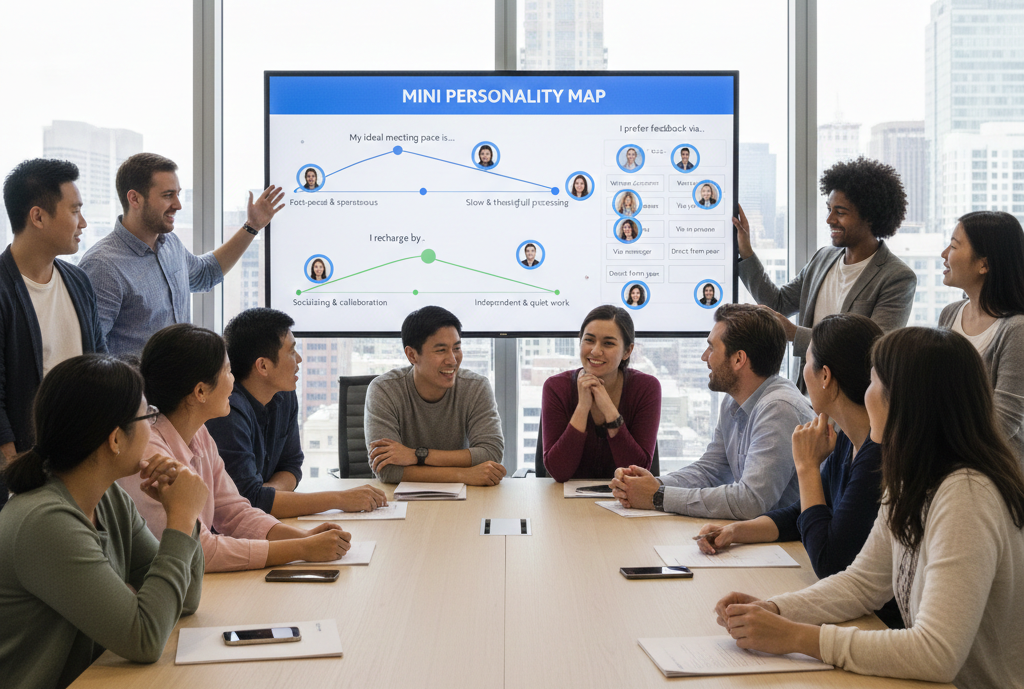
Share 5-6 prompts about work preferences ("My ideal meeting pace is..." / "I recharge by..." / "I prefer feedback via...") and have everyone place themselves on a visual spectrum or grid. Discuss patterns, surprises, and how to adapt workflows to accommodate different styles.
Why this works: Highlights preference differences that cause friction when unacknowledged. The visual mapping helps people remember patterns—"Oh right, Sam needs processing time before responding" or "Jordan prefers direct feedback in the moment." Understanding replaces judgment.
When teams use this: Cross-functional groups, newly formed project teams, onboarding cohorts, or any group experiencing tension around communication or work styles.
The Retreat Experience You Were Hoping For
When a team has time together, something always shifts. We plan retreats with that shift in mind—so your team leaves stronger, clearer, and more aligned. Every piece is designed to support the outcomes that matter to you.
Why Teams Trust The Offsite
We approach retreats with the same care you bring to your business. Every session has a purpose. Every venue is chosen with intention. We design experiences that help teams communicate better, solve faster, and understand each other more clearly—whether they’re leading projects or leading each other.
Some teams come to us for an afternoon of reconnection. Others want three days off the grid to rethink everything. We plan for both with equal depth. Our venues and agendas are crafted to support your goals, not just your logistics.
What We Offer
We bring structure, creativity, and full support to every retreat we plan. Each element is built to serve your goals and remove the guesswork from the process. Here's what you can expect when you work with us:
Curated retreat locations across the U.S.—from serene mountain cabins to urban lofts
Flat-fee pricing and full logistics support (lodging, meals, activities, transportation)
Custom-designed team-building exercises for leadership, collaboration, and fun
Dedicated Retreat Producers and on-site coordination
Real-time budget tracking and stress-free execution
We take pride in the details, because that’s where great retreats are made. When the planning is clean and the team is supported, the breakthroughs tend to follow.
Designed for Impact, Built for Busy Teams
Thirty-minute activities work when someone runs them with skill—reading the room, adjusting on the fly, and creating space for genuine interaction rather than forced participation. The difference between sessions that land and ones that flop usually comes down to facilitation quality, not the activity itself.
The Offsite Co. maintains a 97% client return rate, facilitating team building sessions—from quick 30-minute formats to full multi-day retreats. We've learned what actually strengthens dynamics versus what just fills time. If you're ready to build connections that stick without derailing your calendar, let's talk.
Frequently Asked Questions
What are the best 30-minute team building activities for remote teams?
Activities that use visual engagement and quick interaction work best—Blind Drawing Challenge, Mini Personality Map, and Speed Problem Solving translate well to video calls. Avoid activities requiring physical movement or complex materials. Chat-based participation helps introverts engage without forcing everyone on camera simultaneously.
How often should teams run 30-minute team building activities?
Monthly sessions build stronger patterns than quarterly all-day workshops. Consistency matters more than total time invested—teams running regular 30-minute touchpoints report better communication and collaboration than those doing annual retreats with nothing between. Start monthly, increase frequency if engagement stays high.
Can 30-minute activities work for large teams?
Yes, with the right format. Office Trivia Throwdown and Team Values Sprint scale to 50+ people. Activities requiring small group discussion (Speed Problem Solving, Compliment Carousel) work better for 15-30 people. For larger groups, use breakout rooms or run simultaneous sessions with different facilitators covering the same activity.
What's the biggest mistake teams make with short team building?
Over-explaining the activity. Spending 10 minutes describing a 20-minute exercise kills momentum before you start. State the rules once in 90 seconds, answer clarifying questions, then begin. The second mistake is skipping debriefs—2-3 minutes discussing "what did we notice?" converts fun into learning that transfers to actual work.
Do 30-minute team building activities actually improve team performance?
Short-term: yes, measurably. Teams report better meeting engagement, faster decision-making, and more open communication in the weeks following consistent sessions. Long-term impact requires frequency—one session creates a temporary boost; monthly sessions create sustained behavioral change. Research shows psychological safety (the foundation of high-performing teams) develops through repeated low-stakes positive interactions, which is exactly what these activities provide.
How do you measure whether team building is working?
Track participation rates, voluntary contributions in meetings, cross-functional collaboration frequency, and employee feedback scores. Quantitative metrics: meeting efficiency, project completion timelines, internal referral rates. Qualitative signals: people arriving early to sessions, asking when the next one is, or suggesting activities themselves. If attendance drops or feels obligatory, the format or facilitation needs adjustment.
Can The Offsite Co. design ongoing team building programs for our company?
Yes. We create monthly or quarterly session calendars with rotating activities, facilitator support, and progress tracking. Programs scale from single teams (10-15 people) to company-wide initiatives (100+) with consistent formats across departments. We handle scheduling, facilitation, and adjustments based on what's landing versus what needs refinement.